
Specialised Spine Surgery
Spine Surgery — Minimally Invasive
& Complex Techniques (MIS & Complex Spine)
Do you suffer from neck or low-back pain, sciatica, stenosis, or spinal deformity? At Neuroknife, we provide the full spectrum of spine surgery — from minimally invasive decompressions to complex spinal fusions and adult deformity correction — with microsurgical precision, international-level experience, and advanced technology (O-Arm, navigation, IONM).
Jump to the detailed procedure sections© Neuroknife — Original medical content authored by our physicians, provided exclusively for patient education and information.
Spine surgery at a glance
For every patient, we focus on four essential questions: what exactly is happening, why am I in pain, what options do I have, and what each option means for my daily life.
What is my condition?
Degenerative disc disease, herniation, stenosis, instability, deformity, fracture, or tumor? We explain clearly what your imaging shows and which structure is compressing the nerves or spinal cord.
What are the most common symptoms?
- Persistent neck or low-back pain
- Pain radiating to the arm or leg (sciatica)
- Numbness, weakness, or gait instability
- Bladder/bowel dysfunction in advanced stages
When does surgery help?
- When conservative management fails
- When there is clinically significant nerve or spinal cord compression
- When instability or deformity is present and progressing
What does the Neuroknife team offer?
A combination of minimally invasive techniques, extensive experience in complex spinal disorders, and advanced systems for intraoperative imaging and 3D navigation (O-Arm), aiming for maximum safety and optimal functional outcomes.
Primary procedure categories | Neuroknife
The sections below present some of the main spine procedures performed at Neuroknife, organised by category. Each section links to an in-depth, patient-facing overview of what to expect at Neuroknife — from indications and preoperative planning to the operative technique, postoperative course, and rehabilitation.
Microdiscectomy & minimally invasive decompression
Targeted relief of nerve/root compression with microsurgical precision, designed to support a rapid return to function.
See what to expect →Cervical discectomy / decompression
Techniques to decompress nerves/spinal cord with a focus on safety, stabilisation, and restoration of function.
See what to expect →Lumbar decompression & sciatica management
Depending on the findings: decompression, stabilisation, or a tailored combination of techniques within an individualised plan.
See what to expect →TLIF / MIS-TLIF fusion & stabilisation techniques
When instability is the core issue: stabilisation supported by O-Arm/navigation and neurophysiological monitoring (IONM) in the majority of Neuroknife fusion cases.
See what to expect →Laminectomy for intradural tumor resection
Microsurgical resection of intradural tumors with spinal cord decompression, and stabilisation when required, prioritising maximal safety and neurological preservation.
See what to expect →Adult scoliosis / kyphoscoliosis
Corrective adult deformity surgery (complex spine) with careful indication selection and a structured follow-up strategy.
See what to expect →Posterior cervical fusion
Surgical stabilisation of the cervical spine to restore alignment, relieve pain, and protect the spinal cord.
See what to expect →Fractures & traumatic instability
From minimally invasive stabilisation to complex decompression in cases of instability or neurological compromise.
See what to expect →Failed back surgery / revision procedures
Review of prior operations, redesign of the operative strategy, and a clear risk–benefit discussion before proceeding.
See what to expect →Preoperative planning & technology that makes the difference
The decision for spine surgery is grounded in a synthesis of clinical assessment, imaging, and functional goals — not simply “a single MRI picture”.
- MRI/CT and targeted spinal X-rays (dynamic/whole-spine) when indicated.
- 3D intraoperative imaging and navigation (O-Arm) for all fusion procedures, supporting accurate implant placement.
- Intraoperative neurophysiological monitoring (IONM) in complex cases/deformity surgery for continuous functional surveillance.
- Multidisciplinary collaboration for complex surgical approaches (when required).
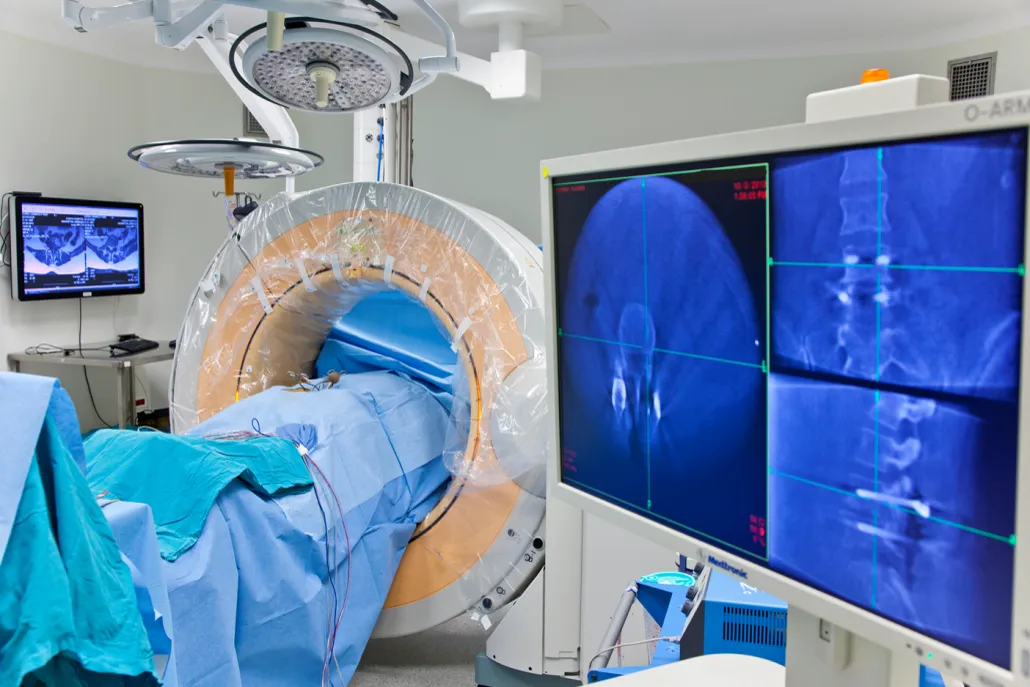
The Neuroknife spine surgery experience
Neuroknife spine procedures are performed in state-of-the-art surgical environments designed for precision, safety, and truly individualised management — including the most complex pathology. Our approach is defined by the integrated use of advanced technology and specialised neurosurgical expertise.
- Use of intraoperative 3D imaging (O-Arm) and navigation — technology available in only a limited number of centres in Greece — enabling millimetre-level accuracy during instrumentation and stabilisation.
- Comprehensive intraoperative neurophysiological monitoring (IONM) for continuous assessment of spinal cord function.
- Application of minimally invasive techniques (MIS) when appropriate, aiming for less tissue trauma, faster recovery, and reduced postoperative pain.
- Close collaboration with specialised anaesthesiology teams, vascular surgeons, and thoracic surgeons for complex cases.
The use of systems such as the 3D O-Arm — a capability offered by only a small number of hospitals in the country — allows Neuroknife, in collaboration with selected centres such as HYGEIA, to deliver cutting-edge techniques with demonstrable benefits in accuracy, safety, and clinical outcomes.
What to expect on the day of surgery
- Arrival & hospital admission.
- Meeting with your neurosurgeon & anaesthesiologist.
- Procedure using the appropriate technologies (O-Arm, IONM, etc.).
- Postoperative monitoring and mobilisation planning.
- Early mobilisation & physiotherapy initiation when there are no restrictions.
I have been diagnosed with a spine problem — what are the first steps?
Our goal is to provide a clear treatment plan: what needs attention now, what can safely wait, and what realistic expectations look like.
Gather your studies
MRI/CT, prior X-rays, and reports from any previous surgeries.
Specialised evaluation
Clinical examination, imaging review & an in-depth discussion of your symptoms.
Conservative care when appropriate
Physiotherapy, medication, targeted injections/blocks.
Surgical plan
We define the technique, levels, and technology to be used — in detail.
Surgery coordination & follow-up
Preoperative assessment, operative date, and a structured follow-up schedule.
Frequently asked questions (FAQ)
Practical guidance on discharge, recovery, wound care, and when to contact the Neuroknife neurosurgical team after spine surgery.
-
Most commonly, procedures address disc and bony (vertebral) pathology, such as:
- Discectomy (removal of part/all of a disc compressing a nerve).
- Foraminotomy (widening of the foramen where the nerve root exits).
- Laminectomy (decompression via removal of lamina and/or osteophytes).
- Spinal fusion (stabilisation by “uniting” segments of the spine).
-
The recovery course depends on the procedure and the severity of the preoperative condition. After a discectomy or foraminotomy, recovery is often relatively rapid.
After a laminectomy or fusion, recovery is typically longer, as the body requires time for stable healing. In fusion surgery, the bone-healing (arthrodesis) process may continue for months.
Pain/numbness/weakness along the previously compressed nerve may persist initially and usually improves gradually.
-
Dressings may loosen or be removed within 2–3 days (per instructions). Mild tenderness or mild redness around the incision is often normal.
Contact your surgeon if you notice:
- increasing redness or swelling,
- drainage or pus (especially green/yellow),
- marked warmth at the site,
- opening of the incision.
-
Follow your surgeon’s specific guidance on when showering is permitted. It is often recommended that the incision remain dry for the first 5–7 days.
- Cover the incision (e.g., protective film) if you have been instructed to do so.
- For the first shower, having assistance can be helpful.
-
- Avoid prolonged uninterrupted sitting (often a position change every 20–30 minutes is advised).
- Do not bend from the waist — bend the knees and “sit” to lift something.
- Avoid lifting/carrying weight (often ~ 4–5 kg in the first weeks, depending on instructions).
- Avoid lifting objects overhead until your team clears you.
If you are prescribed a brace, use it exactly as recommended (e.g., when walking/standing).
-
Driving is usually avoided for the first weeks and should be reassessed when: you can move comfortably, you are not taking strong analgesics, and your surgeon approves.
For longer journeys as a passenger, consider stops every 30–45 minutes for gentle stretching/walking, if safe and permitted.
-
Contact your team immediately if you develop:
- fever or chills,
- worsening pain that does not improve with rest/medication,
- drainage from the incision or significant redness/warmth,
- new/worsening weakness or changes in sensation in the limbs,
- calf pain/swelling,
- chest pain or shortness of breath,
- difficulty urinating or loss of bowel/bladder control,
- severe headaches that do not improve with usual medication.
Early communication helps address any issue promptly and supports a safe recovery.
© Neuroknife — Original medical content authored by our physicians, provided exclusively for patient education and information.
Selected spine procedures performed at Neuroknife
The sections below outline the core categories of neurosurgical spine procedures performed by the Neuroknife team. Each section provides structured information on indications, preoperative planning, surgical approach, and postoperative course.
Degenerative cervical procedures
Degenerative lumbar procedures
Deformity & complex spine
Tumors / Revision / Chronic pain
Trauma / Fractures
Do you need an expert evaluation for a spine problem?
Whether you are dealing with persistent pain, stenosis, deformity, or revision surgery, the Neuroknife team can provide an individualised, evidence-informed plan — spanning the full spectrum from conservative strategies to complex corrective procedures.
© Neuroknife — Original medical content authored by our physicians, provided exclusively for patient education and information.